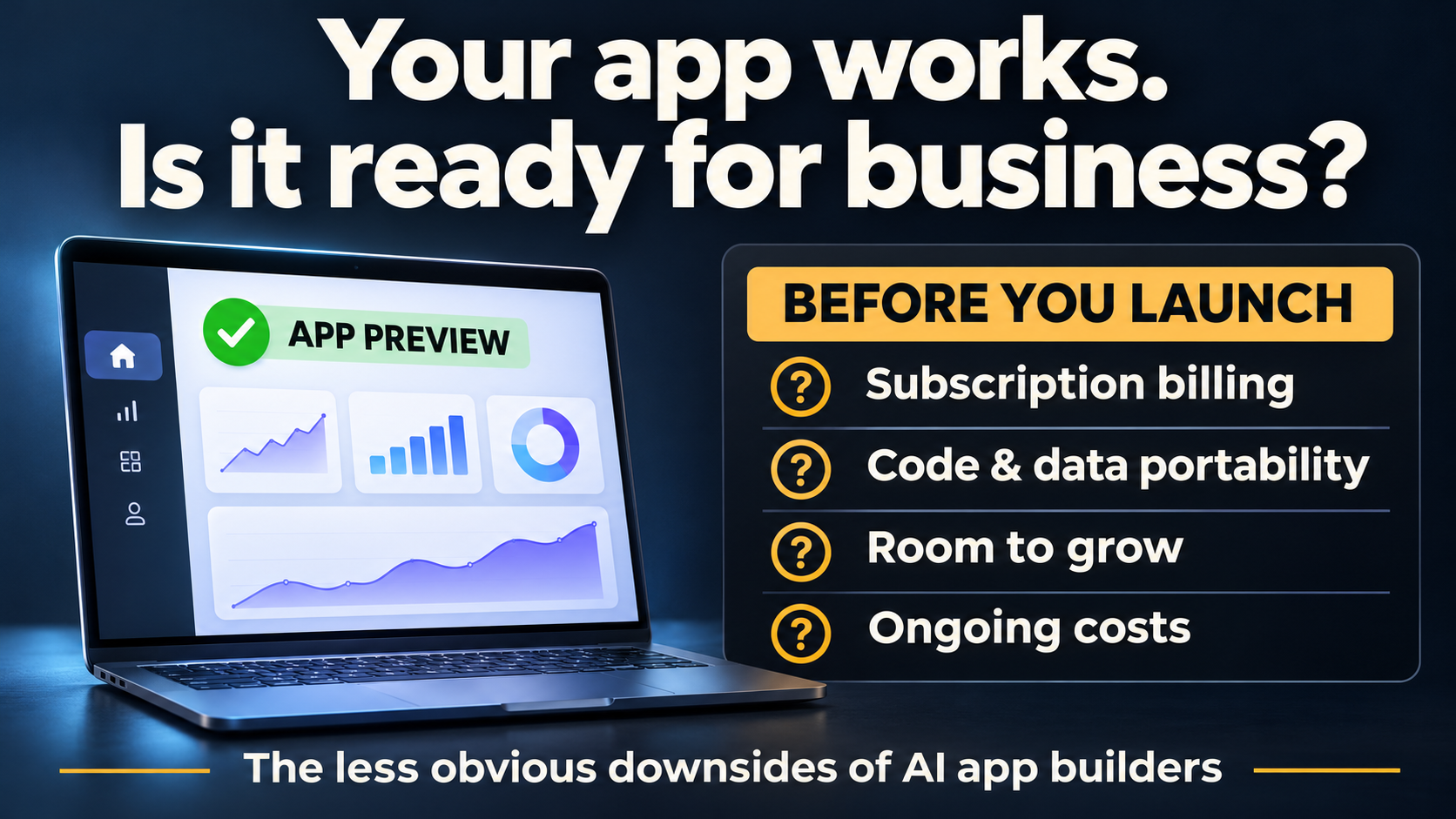
AI app builders can turn an idea into something usable remarkably quickly. For founders without a technical background, that opens doors that once required a development team.
But a working preview is only one milestone. Before committing your budget—or bringing in paying customers—understand what it will cost to build, operate, grow, and eventually move your application.
Budget for corrections, not just creation
With usage-based builders, unsuccessful development attempts can still cost money. Adding a feature, correcting a bug, and asking the AI to repair its previous work may all consume credits. Don’t assume those credits will be returned if the result doesn’t work.
Use clear requirements, make changes in manageable steps, and test critical functions early. Set a spending limit for unresolved problems before seeking technical help.
Know what happens when usage runs out
Your building allowance and your application’s operating allowance may be separate. Credits remaining in one category might not help when another runs out.
Check which limits affect development and which could interrupt customer-facing functionality. Understand whether you can purchase additional capacity, need to upgrade, or must wait for a reset.
Plan around actual activity: transactions, automations, uploads, and AI requests. A user count alone tells you little about operating costs or scalability.
Code ownership is not operational independence
An export button is useful, but ask what the export actually includes.
Your application may depend on the builder’s managed database, authentication, storage, and integrations. Receiving your source code—even custom backend functions—doesn’t necessarily give you the infrastructure required to run it independently.
Moving elsewhere can require replacing those services and adapting the application. For a nontechnical founder, that can mean hiring development help.
Before choosing a builder, understand how you would transfer your code, customer records, accounts, and paid-access arrangements. Getting your code and being ready to leave are different milestones.
App-store submission is not a complete subscription business
Generating a mobile submission file does not automatically supply everything needed to sell subscriptions. Some mobile offerings wrap a hosted web application, preserving its dependence on the original platform.
Confirm that your builder supports the purchasing approach required for your intended stores, markets, and product. A working web checkout does not establish that your mobile subscription flow is ready.
Test renewals, cancellations, restored purchases, and access after payment failures—not just the checkout screen.
Check the commitment before paying annually
An annual discount can become expensive if you discover a mismatch after purchasing. Check whether cancellation returns unused subscription fees or simply prevents the next renewal.
Review support options, too. If a critical feature fails, know how to escalate it and what assistance your plan includes. Customer complaints can reveal useful questions, but check whether reported issues were resolved and whether the limitation still exists.
Choose for the business you intend to run
Before committing, answer five questions:
- Can customers complete the essential workflow reliably?
- What will development and operation cost at realistic usage?
- Does the platform support your payment and distribution plans?
- Who can help when a problem exceeds your technical ability?
- What would it take to move the business elsewhere?
AI app builders can be valuable tools. Understanding their boundaries early helps you decide when to keep building, when to bring in expertise, and how to protect the business taking shape behind the interface.